Adaptation vs. Optimization: Mastering the Agile Balancing Act for Speed and Stability
The age-old debate between adaptability and optimization is reaching a fever pitch as industries grapple with unprecedented technological advancements and shifting market demands. Many teams find themselves entrenched in opposing camps, staunchly advocating for either rapid learning and course correction (adaptation) or unwavering reliability and repeatability (optimization). However, according to Agile Manifesto co-author Jim, this either/or approach misses a crucial point: both are essential, and the real key to success lies in managing the inherent tension between them.
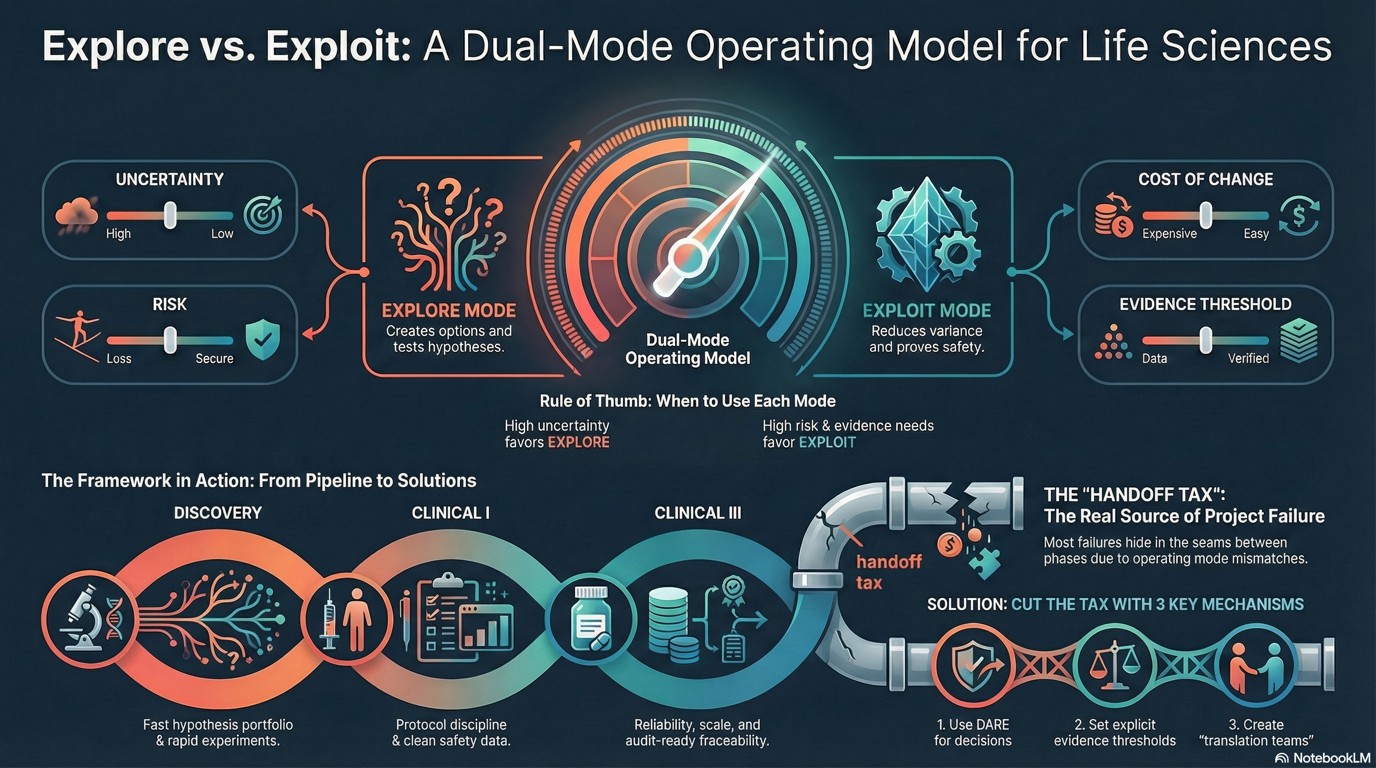
Jim proposes a framework based on two distinct operating modes: 'explore' (adaptation-dominant) and 'exploit' (optimization-dominant). The 'explore' mode thrives on treating work as a series of hypotheses, optimizing for rapid learning and uncertainty reduction. This isn't about embracing chaos; it's about streamlining the learning loop to quickly identify what works and what doesn't. Conversely, the 'exploit' mode focuses on treating work as a well-defined system, optimizing for reliability and variance reduction under constraints. This mode isn't about stifling innovation with bureaucracy; it's about ensuring consistent and dependable execution.
The challenge lies in recognizing when to prioritize one mode over the other. Factors such as uncertainty, risk, cost of change, and the required evidence threshold should all inform the decision-making process. The critical point of failure often occurs during handoffs between the 'explore' and 'exploit' modes. This 'handoff tax,' as Jim calls it, represents the hidden costs associated with transitioning work from the exploratory phase to the implementation phase. This often results in wasted effort and delays.
One flawed early attempt to address this tension was the creation of bimodal IT, where exploratory work was siloed in one organizational unit and stable delivery in another. This approach, while seemingly logical on paper, often devolved into turf wars between innovation champions and stability police, ultimately increasing handoff tax and hindering overall efficiency. Jim argues that the capability to navigate this tension must reside within every individual involved in decision-making, from team members to executives.
To facilitate this dynamic balancing act, Jim introduces the DARE framework: Deciders, Advisors, Recommenders, and Execution stakeholders. This framework ensures clear decision rights and accountability without succumbing to consensus-by-exhaustion, allowing for more voices without giving everyone a veto. DARE empowers teams to tailor their approach based on the specific context and requirements, avoiding the pitfalls of blindly adhering to rigid methodologies. Ultimately, success lies in designing workflows that effectively manage the tension between adaptation and optimization, recognizing that both are vital components of a high-performing organization.
Alex Chen
Senior Tech EditorCovering the latest in consumer electronics and software updates. Obsessed with clean code and cleaner desks.
Read Also

Y Combinator CEO's AI Obsession: Genius or Delusion?
Garry Tan, head of Y Combinator, is pushing the boundaries of AI-assisted coding with his open-source 'gstack' setup, designed for Anthropic's Claude. But is this a revolutionary leap forward, or just another case of Silicon Valley hype? Critics are divided, questioning the tool's uniqueness and real-world value.

AI's Ephemeral Memory: How to Build Durable Understanding with Context Anchoring
Generative AI coding assistants offer incredible potential, but their short-term memory can lead to frustrating context loss. Rahul, a Principal Engineer at Thoughtworks, introduces 'Context Anchoring,' a powerful strategy to externalize and preserve crucial decision-making processes, ensuring long-term alignment and architectural integrity in AI-assisted development.

Parallax: AI Revolutionizes Software Development with Local-First Orchestration
Imagine an AI co-pilot that lives directly on your machine, streamlining your coding workflow without relying on cloud connectivity. Parallax promises to be just that, offering a local-first AI orchestrator designed to boost software development productivity.
Agen: AI Agents Emerge to Automate Software Development
The quest for fully autonomous AI coders takes a leap forward with Agen, a new platform designed to automate software development tasks. Agen promises to streamline the coding process, potentially revolutionizing how software is built and maintained.