Fear Gauge Flashes Red: Is Bitcoin Poised to Capitalize on Market Turmoil?
Key Takeaways
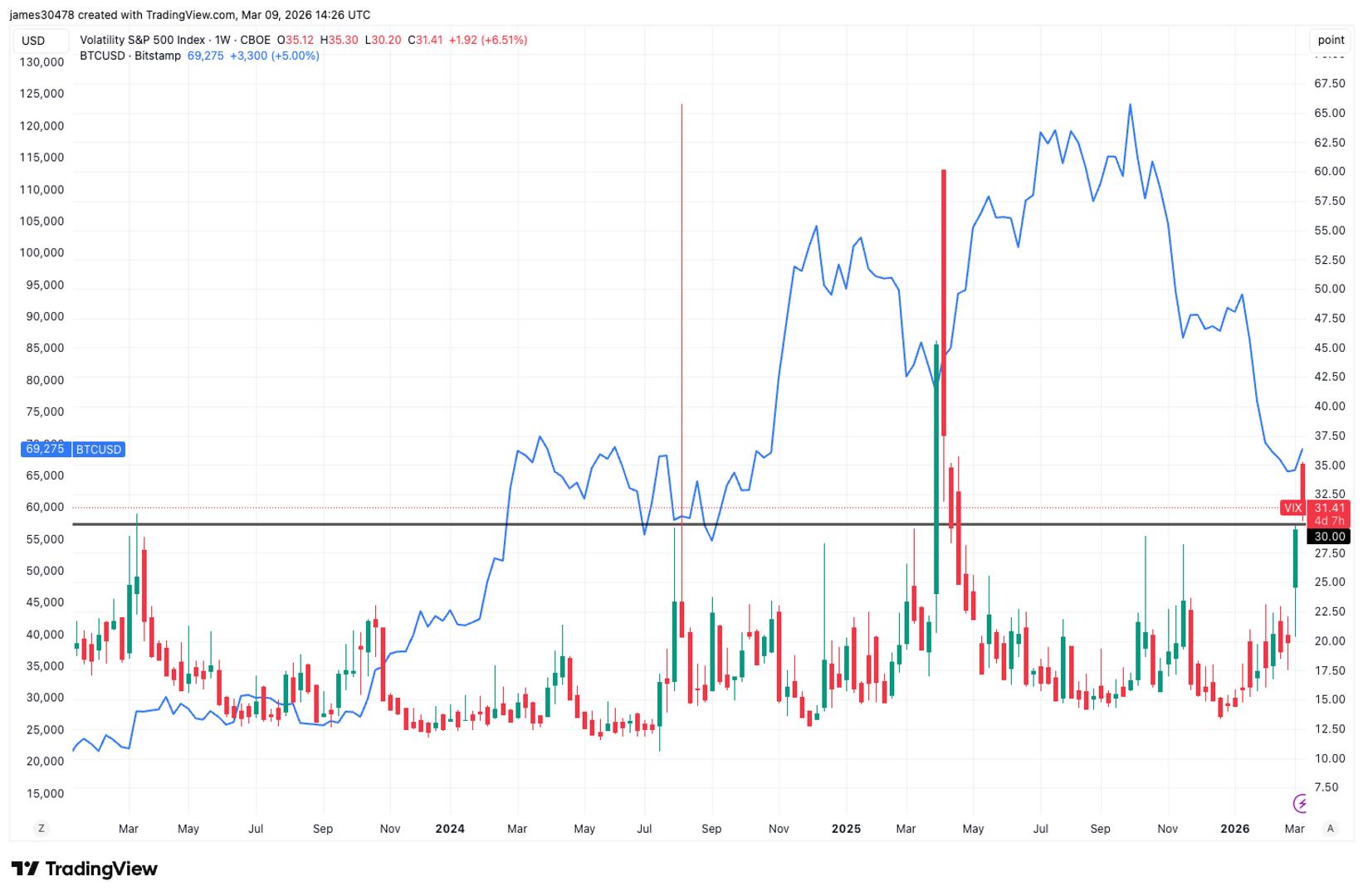
- The CBOE Volatility Index (VIX), a key indicator of market fear, has surged to its highest point in a year, surpassing 35.
- Bitcoin is bucking the trend, rising approximately 5% in the last 24 hours and trading above $69,000, while traditional assets like stocks and gold decline.
- Historically, spikes in the VIX have often coincided with local bottoms for Bitcoin, suggesting a potential buying opportunity.
- Bitcoin's volatility index (BVIV) already peaked, indicating the crypto market may have priced in current anxieties ahead of traditional markets.
Global markets are experiencing a surge in volatility, highlighted by the sharp increase in the VIX, often referred to as Wall Street's "fear gauge." This index, which reflects expected market volatility based on S&P 500 options prices, has climbed to levels not seen in nearly a year, signaling heightened anxiety among investors.
The market jitters arise from a complex interplay of factors, including significant fluctuations in oil prices. West Texas Intermediate (WTI) crude oil briefly touched $120 per barrel before settling near $100, contributing to the overall atmosphere of uncertainty. These conditions are impacting both equities and perceived safe-haven assets, as U.S. stocks and gold both experienced declines.
Interestingly, Bitcoin is deviating from the established pattern. While traditional markets grapple with volatility, the leading cryptocurrency has demonstrated remarkable strength, showing an approximate 5% increase over the preceding 24 hours and trading above $69,000. This divergence raises questions about Bitcoin's evolving role in the global financial landscape.
Historically, periods of intense market fear, as reflected by VIX spikes, have often presented strategic entry points for Bitcoin investors. Instances such as the trade-related market disturbances in April 2025, where Bitcoin found support near $75,000 amid a VIX surge to 60, and the yen carry trade unwind in August 2024, which saw Bitcoin drop to around $49,000 as the VIX exceeded 64, support this observation. A similar trend was observed during the Silicon Valley Bank crisis in March 2023.
Further supporting the narrative that the crypto market might be ahead of the curve, the Bitcoin Volmex Implied Volatility Index (BVIV) already experienced a significant spike in early February, reaching its highest level since August 2024. This suggests that the crypto market may have already priced in the current market anxieties before they fully impacted traditional finance. The BVIV has since retraced, now hovering just above 60.
While the current VIX level near 30 suggests that volatility in traditional markets may still have room to run, the observed divergence between Bitcoin and traditional assets presents a compelling case for those seeking alternative investment strategies during times of economic uncertainty. The question remains: can Bitcoin sustain its upward momentum while the rest of the market navigates turbulent waters?
Why it matters
The divergence between Bitcoin and the broader market signals a potential shift in investor perception of the cryptocurrency. If Bitcoin continues to perform well during periods of traditional market turmoil, it could solidify its position as a hedge against economic uncertainty and attract further institutional investment, ultimately impacting the long-term value and stability of the digital asset.
Michelle Ross
Crypto Market LeadTracking the blockchain revolution since 2013. HODLing through the highs and lows.
Read Also

SEC Explores 'Safe Harbor' for Crypto: A Potential Game-Changer for Innovation?
The Securities and Exchange Commission is considering establishing 'safe harbor' exemptions for cryptocurrency companies, potentially offering a pathway to regulatory clarity and fostering innovation. This move could significantly alter the landscape for crypto startups seeking to raise capital within the US.

Stratton Thwarts Crypto-Fueled Challenge in Illinois Senate Primary Upset
In a closely watched Illinois Senate primary, Lieutenant Governor Juliana Stratton secured a decisive victory over Representative Raja Krishnamoorthi, despite a massive influx of crypto-backed funding supporting her opponent. The outcome signals a potential shift in the influence of digital currency interests in state-level elections.

Bitrefill Targeted by Lazarus Group Cyberattack: Customer Data and Funds at Risk
Cryptocurrency e-commerce platform Bitrefill has confirmed a sophisticated cyberattack, pointing fingers at the notorious North Korean hacking collective, Lazarus Group. The breach exposed sensitive customer purchase records and led to a loss of funds, highlighting the persistent vulnerability of even security-conscious crypto businesses.

SEC Signals Shift: Most Crypto Assets Escape Securities Regulation
In a move signaling a potentially seismic shift in cryptocurrency oversight, the SEC has indicated it will treat the majority of crypto assets as non-securities under federal law. This interpretive guidance, a first step since collaborating with the CFTC, aims to clarify the regulatory landscape amidst ongoing legislative efforts to define digital asset market structures.